Food Environments: Shaping the Choices We Make, Every Day
When you think about your last meal, maybe it was a hurried breakfast, a canteen lunch, or an evening snack; it may have felt like a personal choice. But in truth, that choice was shaped long before you picked up your plate.
What foods were available in your neighborhood? What could you afford? What did the packaging or advertisements nudge you towards? What cultural traditions told you what was “good” or “filling” or “celebratory”?
This invisible web of factors that surrounds our daily meals is what experts call the food environment. And in India, food environments are often where the battle for nutrition, sustainability, and equity is quietly won or lost.
What do we mean by food environments?
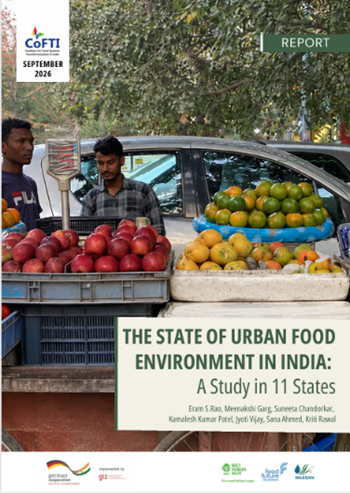
Food environments are the physical, economic, political, and socio-cultural spaces where people interact with food. They determine not just what food we eat, but how we acquire it, prepare it, and value it. Think of them as the stage on which every food choice plays out:
- Physical: The school canteen that sells samosas but not fruits; the local bazaar where millets are harder to find than packaged snacks.
- Economic: When a bottle of soda is cheaper than a glass of milk, or when rising vegetable prices push families towards filling but less nutritious staples.
- Political: Subsidies that support wheat and rice over pulses and millets, or policies that make front-of-pack labelling optional rather than mandatory.
- Socio-cultural: Traditions that celebrate festive foods high in sugar and ghee, or gender norms where women eat last and least in many households.
Together, these environments shape what is accessible, affordable, available, and acceptable. And they are not always fair. Children today grow up in an “infodemic” overloaded with conflicting messages on food, where junk is aggressively marketed and healthy options are harder to sustain.
The paradox of plenty
India is a food-surplus nation. Our markets are overflowing with grains, fruits, vegetables, oils, and packaged goods. And yet:
- — 189 million Indians remain undernourished.
- — A third of children are stunted.
- — Obesity and diet-related diseases are on the rise.
"Food is not a straight line from farm to fork; it is a complex web tied to markets, rights, culture, and power. The paradox lies not in production but in distribution, affordability, and desirability"
— Anshuman Das, Facilitator, Agroecology Action Lab
Ultra-processed foods, high in salt, sugar, and fat, are often cheaper and more aspirational than indigenous grains or greens. Fresh produce may be abundant in rural areas but priced out of reach in urban slums. Policies may incentivize high-yield crops while ignoring climate-resilient, nutrition-rich varieties like millets.
The result? Food environments that systematically make the unhealthy choice the easy choice.
The human face of food environments
To make this real, imagine two children:
In a peri-urban neighborhood, a young girl buys her after-school snack. The kirana store stocks chips and soft drinks at eye level, but no fruits. A 10-rupee packet of wafers fits her pocket money better than an apple.
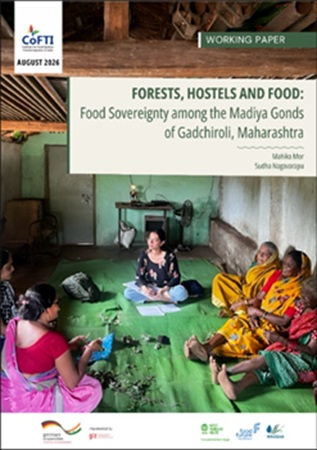
In a tribal village, a boy’s family grows diverse crops but sells most of them to middlemen. At home, his plate is filled with rice and watery dal. The nutritious millets his grandparents ate rarely make it to his meal.
These are not simply “choices”. They are the outcomes of food environments that limit what’s visible, affordable, and aspirational.
As Rinka Banerjee (Facilitator, Food Loss & Waste Action Lab) puts it, this inequity extends further: while millions go hungry, enormous amounts of food are lost in supply chains or wasted at consumer level. A broken food environment is one that wastes abundance while perpetuating scarcity.
What the Food Environments Action Lab aims to do
The Food Environments Action Lab under CoFTI is designed to step back and look at the bigger picture. Instead of telling individuals to “eat better,” it asks: how do we reshape the environment so that the healthy choice becomes the easy choice?
The Lab focuses on:
- Accessibility – Ensuring nutritious foods are physically within reach, whether in schools, workplaces, or marketplaces.
- Affordability – Nudging policies and markets so that fruits, vegetables, pulses, and millets are not costlier than empty-calorie foods.
- Availability – Supporting supply chains that bring local, seasonal, and indigenous foods to the fore instead of phasing them out.
- Acceptability – Shaping aspirations through awareness, food literacy, and cultural pride in traditional diets.
This means piloting interventions like:
- — Healthier school canteens where fruits and nuts are as visible and affordable as chips.
- — Retail “nudges” where stores promote seasonal produce at the front.
- — Front-of-pack labelling that helps families decode nutrition information at a glance.
- — Policy dialogues that shift incentives from calorie-heavy monocultures to climate-resilient, nutrition-dense crops.
Connecting the dots
Food environments do not exist in isolation. They connect with everything the other Action Labs are working on:
- — From Action Lab 1 (Diets & Consumption): Nutrition literacy ensures that when healthier options are available, people understand and choose them.
- — From Action Lab 2 (Agroecology): Local and agroecological foods need environments that make them accessible and desirable.
- — From Action Lab 3 (Food Loss & Waste): Redesigning environments also means reducing wastage in supply chains, retail, and homes.
The power of the Food Environments Lab lies in weaving these threads together, ensuring that from farm to fork, the surroundings enable better outcomes.
A vision for tomorrow
Imagine a future where:
- — Children at schools learn to read labels before picking snacks and carry that skill home.
- — A local bazaar proudly sells moringa leaves and millets alongside rice and wheat, making local superfoods accessible to all.
- — Packaged foods carry simple, honest labels, and ads celebrate health rather than excess.
- — Women and men alike sit down to equal portions at the family table.
This is not a distant dream. It is the ambition of the Food Environments Action Lab – to shift India’s food environments from being biased towards convenience and profits to being designed around health, sustainability, and equity.
Conclusion: Building healthier backdrops for choice
Our food choices are never made in isolation. They are shaped by the backdrops around us – the shelves we shop from, the ads we watch, the policies that guide supply, and the cultural norms we live by.
Transforming these backdrops is as critical as transforming what’s grown in fields or taught in classrooms. Because when food environments change, the ripple effects touch everyone: farmers, families, and future generations.
At CoFTI, we believe that food environments are not just settings where choices happen, they are the very levers of change. By reshaping them, we can create a future where every plate in India carries not just food, but fairness, resilience, and health.