Assam's Ekho-Ebidh Xaak: A Living Memory of the Land
“Aidhon! Bring the Bamboo basket. Let's go and collect Ekho-Ebidh Xaak”. I remember my great grandmother (aita), Savitri Kachari, on the morning of Goru Bihu, calling out to us. My energetic Aita would then step out, with a betel nut tucked into her cheek, and a walking stick in hand. Aidhon — a made-up word meaning mother and wealth — was how she lovingly addressed me.
Little me obediently lifted the bamboo basket and followed her to the backyard of our Titabar home, where tradition waited in the wild grasses and plants that grew unapologetically. Time passed quietly, as it always does. My aita is no longer here, yet those practices and flavours remain, living on as gentle memories.
A Food Heritage Rooted in Biodiversity
In Assam, food has always carried memory. It is simple, fresh, lightly spiced, and deeply tied to the land. The kitchens here speak softly — of rivers and fields, of seasons turning, of greens gathered at dawn. Among these traditions, one practice stands apart for both its abundance and intimacy: Ekho-Ebidh Xaak.
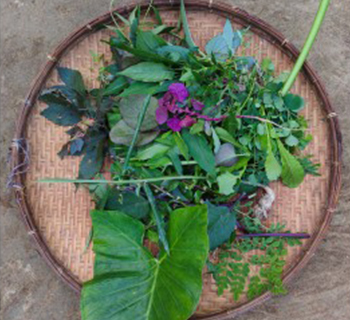
Ekho-Ebidh Xaak is not an everyday dish. It appears once a year, during Rongali Bihu, the spring festival that marks the Assamese New Year. It is a preparation made from 101 varieties of edible greens, gathered from fields, backyards, riverbanks, forests, and kitchen gardens — some cultivated, many wild. Ekho-Ebidh means 101; Xaak means leafy greens and herbs. Together, they form a dish that is less about taste alone and more about connection to nature, health, to a collective, community life.
Elders say that Ekho-Ebidh Xaak is a reminder that the land gives generously, and the festival marks a special day to pass down this knowledge to their youngsters. On this day our elders tell us where and how to look at the boundless biodiversity of the Assamese landscape.
Bountiful Bihu: 101 Greens on the Plate
As Bihu approaches, the landscape itself seems to prepare for this festivity. New leaves sprout on trees, flowers bloom, rivers sparkle under the sun, and the air carries the scent of spring. The fields seem to hum. The excitement of the people mirrors this renewal. It is in this charged moment — when winter has just loosened its grip — that families begin collecting greens.
Women lead this work. Mothers and grandmothers take children along to fields and backyards, to the edges of ponds and footpaths. They point, pluck, and explain. Sometimes they sing a Bihu song or dance to its lilting tune, turning the moment into memory.
“This one heals cuts,” the elders say, holding up Sukloti Xaak.
“Eat this for strength,” they tell the children, handing them the curly greens of Dhekia Xaak, rich in iron.
“This helps your stomach,” they add, smiling at Bhedailota, known for its strong smell.
Children count carefully. One. Two. Ten. Fifty. Ninety-nine. A hundred! The goal — 101 — becomes a game, a challenge,
a small triumph. If one family cannot find a particular leaf, another shares theirs. No plate is meant to be incomplete.
A Bihu song accompanies the Xaak-gathering exercise:
“চতৰে শেষতে বসন্ত আহিলে,
গছে ডালে সলালে পাত
বিহুৰে বতৰত ঘৰৰ জুইশালতে
বনাই এশ এবিধ শাক”
These lines describe how winter ends and spring arrives, how the trees change their leaves and life awakens. During Bihu where families cook Ekho‑Ebidh Xaak with a hundred and one greens by the warm hearth at home, this song beautifully illustrates the alignment of nature’s renewal with the happiness of the people, showing how culture, emotion, and environment are closely intertwined.
The kitchen, in this context, becomes the centre again. Greens are washed, chopped, boiled lightly, seasoned gently. There is little oil, no heavy spice. The flavours remain clean, green and alive. Ekho-Ebidh Xaak is often called “nature’s own pharmacy,” and elders insist it protects the body from seasonal illness, detoxifies, and strengthens immunity. Each herb has a role, a story, a purpose and together they form a small herbal universe on a plate.
The number 101, elders like Dr. Chandra Kamal Chetia, a professor at Mahapurush Srimanta Sankardev University, Nagaon explain, is not rigid. Across Assam, different communities follow different counts—seven varieties (Saat Xaaki), five (Ponsotita), or other auspicious numbers like nine or 108. Among the Ahoms, 101 holds special meaning, reflected even in marriage rituals like Soklong. What matters more than the number is the belief shared across communities: eating these greens at the turn of the season protects the body for the year ahead.
Knowledge as the Bridge Between Generations
Ekho-Ebidh Xaak is also a bridge between generations. Knowledge passes through walking, plucking, tasting. Women are its custodians. Yet today, this flow is weakening. Urbanisation, convenience foods, shrinking green spaces, and changing lifestyles have distanced younger generations from these practices. Many no longer recognise the plants, their names, or
their uses.
The landscape, too, is changing. Forests are thinning. Fields are empty of diversity. Wild greens disappear under concrete, pesticides, and climate shifts. In towns and cities, uncultivated plants are rare. Climate change alters rainfall and soil. Chemical farming weakens delicate species. Slowly, quietly, the conditions that made Ekho-Ebidh Xaak possible are eroding.
And yet, the tradition persists — fragile, but alive.
Ekho-Ebidh Xaak is more than food. It is cultural identity, ecological wisdom, and collective memory. It holds stories, songs, healing knowledge, and relationships with land. Preserving it means documenting, reviving home gardens, listening to elders, and helping youth, like me, understand what seems ordinary, but often carries great value.
If Ekho-Ebidh Xaak survives, it will not be because it was preserved in a recipe book alone — but because people continued to walk the backyards, and commons, to bend down and pluck a leaf they recognised, and remembered why it mattered.