Agroecology in Action: Putting Communities and Nature at the Heart of Food Systems
The UN Food and Agriculture Organization (FAO) defines agroecology as a holistic approach that brings together ecological and social principles to design and manage sustainable agriculture and food systems. At its core, agroecology looks at how plants, animals, people, and the environment interact, and how these relationships can be strengthened to create food systems that are both environmentally sustainable and socially fair.
Agroecology is not just one thing. It is a science, a set of practices, and a social movement. Over time, it has grown beyond a focus on farms and fields to include the entire food system — from production and processing to supply chains, markets, diets, and consumption. Today, agroecology is a transdisciplinary field, bringing together ecological, cultural, economic, technological, and political perspectives.
This matters because we can no longer view food as separate from livelihoods, health, or natural resource management. Climate change, biodiversity loss, malnutrition, and farm productivity (and hence farmer welfare) are deeply connected. Addressing them requires systems thinking — looking at the whole picture rather than isolated parts.
The connection between people and the planet lies at the heart of the global push for sustainable development. Ending poverty and hunger, while protecting natural resources and respecting human rights, is only possible through integrated and holistic approaches. Agroecology offers exactly that.
Moving Beyond a Narrow View of Food
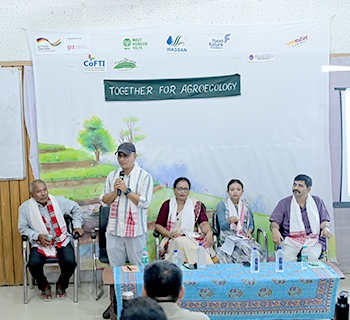
When we talk about food, it is easy to imagine a simple chain: a farmer grows it, a market sells it, and we consume it. But, as Anshuman Das, Lead Expert, Agroecology at Welthunger Hilfe, which is a core partner of CoFTI, reminds us, "this is a commodified” way of seeing food — and it leaves out what truly matters."
"Food is deeply tied to the soil it grows in, the climate that shapes it, the traditions that give it meaning, and the policies that govern how it moves," explains Das. It connects farmers and consumers, workers and entrepreneurs, children and elders. It affects our health, our environment, and our economies. "Because food touches everyone, everyone has a role to play in transforming food systems," sys Das.
Agroecology helps us see these connections clearly. It is not just about farming techniques; it is a way of understanding how nature, culture, markets, and governance are linked.
One Umbrella, Many Ideas
Over the years, concepts of organic farming, permaculture, and sustainable agriculture have become buzzwords. "All of these approaches are important. What agroecology does is bring them together under one umbrella, guided by shared principles that work for farmers, consumers, and the planet," says Das explaining the core idea of agroecology.
The FAO outlines 13 principles of agroecology, which include caring for soil and biodiversity, recycling nutrients, improving efficiency, ensuring fair prices, protecting rights, and building knowledge collectively. These principles remind us that food systems are not only about productivity. They are about dignity, justice, and resilience.
Agroecology in Practice: COFTI’s Action Lab
In COFTI’s Agroecology Action Lab, these ideas are put into practice.
The Agroecology lab is led by Consortium for Agroecological Transformation (CAT)—a dynamic force aimed at integrating, practising and populariing agroecology across India. At the core of CAT's work is the development of a landscape-based approach to agroecological transformations.
As Das explains, the goal is not to apply one practice at a time, but to create living examples of food system transformation. These pilot areas will act as demonstration hubs, showing what is possible when different actors work together, and offering a space for learning across COFTI’s other Action Labs.
For smallholder farmers, agroecology offers a pathway to resilience. It can reduce dependence on expensive chemical inputs, restore soil health, diversify crops, and strengthen connections with consumers. But farmers cannot do this alone. They need supportive policies, fair markets, and informed consumers who recognise the true value of their food.
A Shared Future
The long-term vision of CoFTI's Agroecology Action Lab is to help build food systems that are ecologically sound, socially fair, and nutritionally secure. By showing that this approach works across different regions, the Lab aims to inspire wider adoption and scaling.
As Das reflects, food is the most common thread connecting us all. And because it connects us all, caring for our food systems is a shared responsibility. And towards this shared vision, agroecology provides a pathway for not just how we grow, but how we consume, share care for each other — the people and the planet.