A Leaf, a Season, a System: Indian Pennywort and the Future of Farming
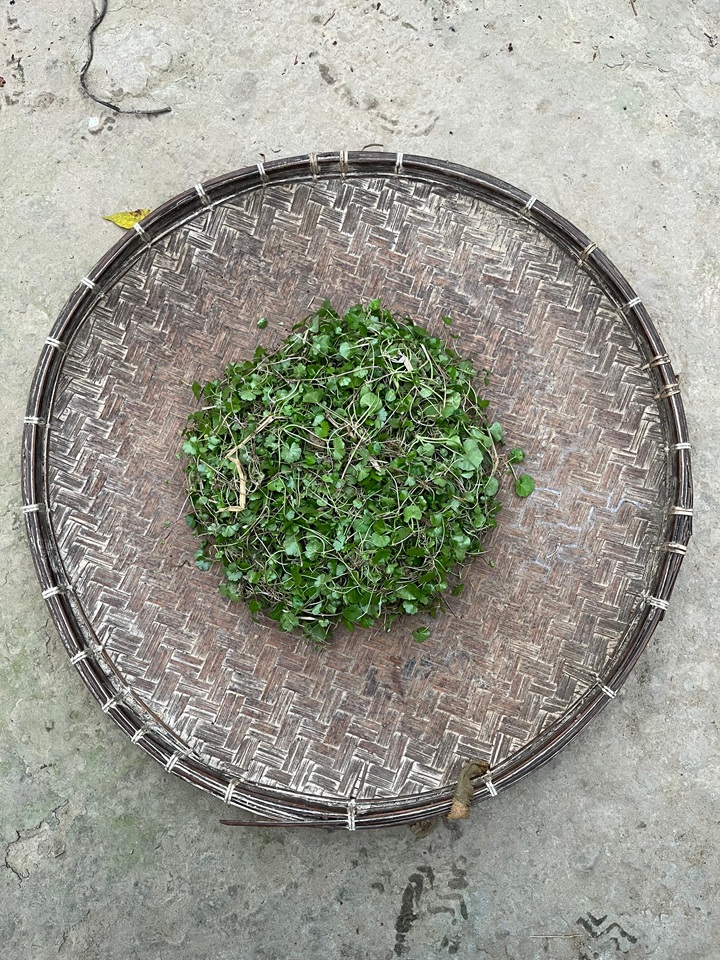
Every year after the paddy harvest in Assam, when the golden fields slowly turn dry and silent during the season of Fagun (mid-January to mid-March), something small yet meaningful begins to appear beneath the layer of fallen paddy straw. Under this natural cover grows Indian Pennywort or ‘Manimoni’ (মানিমুনি ) in Assamese scientifically known as ‘Centella asiatica’. We did not sow it, we did not water it, and we did not protect it with fences. It emerges on its own. As farmers, we understand that such growth is not accidental. It is a sign that the soil still holds moisture, organic matter, and life. The presence of Manimoni after harvest tells us that the land has not been completely disturbed and that the natural cycle is still functioning.
A Seasonal Food and Traditional Medicine
In our villages, we commonly see two types of Manimoni— “Xoru Manimoni” with smaller leaves and “Bor Manimoni” with broader leaves. During the dry months between January and March, when dust increases and people often suffer from cough, mild fever, and stomach problems, many Assamese households prepare Manimoni soup with local chicken or consume it as chutney or juice. Our elders always believed that nature provides what the body needs in each season. Modern studies now confirm that Centella asiatica contains vitamins, antioxidants, and important compounds that improve memory, digestion, skin healing, and immunity. But for us, its value is not only chemical or nutritional. It is connected to seasonal rhythm, cultural practice, and the wisdom of observing nature.
Traditional paddy harvesting methods played a key role in supporting this herb. In many parts of Assam and the Northeast, farmers harvested only the upper portion of the paddy plant, leaving most of the straw standing in the field. Over time, this straw fell naturally and formed a protective layer over the soil. This mulch reduced direct sunlight exposure, conserved soil moisture, moderated temperature, and created a favourable condition for microorganisms. Under such protection, herbs like Manimoni and wild strawberry, locally known as ‘Gorukhis’, would grow naturally. The straw did not become waste; it became a shield for the soil. This simple practice – it maintained fertility without external inputs.
Manimoni as a Sign of Living Soil and its ecology
The natural growth of Manimoni indicates that the soil ecosystem is balanced. It grows where moisture is retained and where microbial life is active. Its creeping structure covers the top soil, preventing erosion and reducing evaporation during dry months. When the monsoon arrives, these herbs decompose and add organic matter back into the soil. This cycle strengthens soil fertility in a natural way. Manimoni, therefore, acts as both ground cover and green biomass. It supports the soil quietly and continuously. When we see Manimoni spreading in the field, we know that the soil is breathing.
The Impact of Chemical Farming, Mechanization and Soil Disturbance
Today, this natural cycle is slowly weakening. With the expansion of chemical-intensive farming, herbicides and synthetic fertilizers are increasingly used. In such systems, all spontaneous plants are labelled as weeds and removed without understanding their ecological importance. Herbicides do not distinguish between harmful invasive plants and beneficial medicinal herbs. Manimoni is often destroyed along with other species. Chemical residues in the soil disturb microbial populations and reduce the natural regenerative capacity of the land. As soil biology declines, the environment becomes unsuitable for herbs like Manimoni to survive.
Mechanization has further transformed our fields. Combine harvesters cut paddy close to the ground and often remove or scatter straw unevenly. Heavy machines compress the soil, reducing aeration and water infiltration. Without sufficient straw cover, the soil becomes directly exposed to the sun. High surface temperatures kill beneficial microbes and reduce moisture retention. In such exposed conditions, Manimoni cannot establish itself. The loss of mulch leads to the loss of ground-covering herbs, and gradually the soil becomes biologically weak. To compensate for declining fertility, farmers are encouraged to apply more synthetic fertilizers. What was once a self-sustaining cycle becoming dependent on external inputs.
A critical component of this transition is the cycle of paddy straw burning after Xali harvest to prepare fields quickly for Boro transplantation. Research across India has shown that straw burning significantly reduces soil organic carbon, harms microbial populations, and contributes to greenhouse gas emissions. In Assam’s wetland ecosystems, where soil fertility depends heavily on organic matter and biological activity, such practices are particularly damaging. As soil quality declines, farmers increasingly depend on synthetic fertilizers and pesticides. High-yielding and hybrid varieties, which often lack resilience to submergence stress and local pest dynamics, further intensify chemical reliance. Over time, agriculture shifts from regenerative nutrient cycling to an extractive, input-driven system.
Loss of Biodiversity, Cultural Knowledge and Future Farming
The disappearance of Manimoni is not just an ecological issue; it is also a cultural loss. For generations, people have relied on this herb for household remedies and seasonal nutrition. Ethno-medicinal practices and traditional veterinary knowledge often depend on plants collected from the field. When biodiversity declines due to chemical control and monocropping, these knowledge systems weaken. Food sovereignty is not only about rice production; it includes access to diverse foods and medicinal plants. When fields become uniform and chemically controlled, we lose both ecological diversity and cultural heritage.
In a time when climate patterns are changing and dry spells are becoming more unpredictable, mulch-based and biodiversity-rich farming systems offer greater resilience. Straw cover and natural herbs protect soil moisture and maintain biological balance. If we continue removing straw, compacting soil, and promoting monocropping with heavy chemical use, we may face declining productivity and increasing input costs in the coming years. The absence of Manimoni in our fields could be an early warning sign that soil health is deteriorating.
Questions for Our Near Future
If we continue replacing traditional straw-based systems with mechanized and chemical-intensive farming, what kind of soil will remain for the next generation? If herbs like Manimoni disappear from our landscapes, how will we sustain our traditional healing practices and local food systems? When soil loses its living cover and microbial diversity declines, how long can synthetic inputs maintain productivity? And in the coming years, will we realise that the loss of small plants like Manimoni was not minor, but a signal that our farming system itself was losing its life?